Happy Chirp · Ep 8 · Oct 7, 2021 · 0:49:26
Living Abroad & South-Asian Culture Ft. Hufsa Zia
Exploring the life of a Pakistani-American girl and how different it is from ours. Meet Hufsa, Muzamil's niece.
with Hufsa Zia
5 min read
Today I sit down with my niece Hufsa, who is visiting from the United States. She’s 22, born and raised in North America, and she calls me choti mumani. We talk about what it’s like to grow up Pakistani in a mostly white world, the blurry line between culture and religion, and the small moments that shape who you become. This conversation is honest, layered, and full of the kind of reflections that only come when you’ve had to figure out where you belong.
The early years and the pressure to fit in
Hufsa tells me that as a child, her world was small. “I knew three things existed: Pakistan, Canada, and Houston,” she says. That innocence didn’t last. When her family moved to the US and she started public school, the pressure to assimilate hit hard. Kids made fun of her for not knowing brands like Aeropostale or Abercrombie. She and her brother stopped speaking Urdu because classmates mocked them. “At that point if you hear someone making fun of you, you’re just not gonna try,” she says. It’s a quiet kind of loss, the way a language can slip away when you’re just trying to survive the schoolyard.
Finding the good in the culture
But as she got older, Hufsa started to see what she had been taking for granted. She points to the deep family orientation that so many Desi kids grow up with. “I had a friend in high school who was American, and she would ask us to hang out and we’d have to say sorry we have a family thing,” she recalls. That moment made her realize how much she valued that togetherness. She also talks about basic etiquette, the way you’re taught to greet everyone kindly and offer water to guests. “It teaches you how to be a good person,” she says. These small things, often invisible until you meet someone who doesn’t have them, became a source of pride.
The toxic threads we can’t ignore
Of course, not everything is worth holding onto. Hufsa doesn’t shy away from naming the harder parts. “Log kya kahenge, what will people say, that thing that I feel like is emphasized in every household,” she says. The constant comparison, the aunties who ask personal questions just to measure you against their own kids, the way gossip can stop you from living your life. And then there’s colorism. “The gora complex here it’s very real,” she says, recalling how even as an 11-year-old she was thinking about fair and lovely creams. She talks about rishta culture too, how it can feel like a “competition of looks” that’s dehumanizing. “It’s like you’re picking out objects,” she says. These aren’t easy things to say, but she says them plainly, without drama.
College, culture shock, and choosing your own boundaries
When Hufsa went to university, she faced a whole new world. She grew up sheltered, and suddenly she was surrounded by drinking, drugs, and people from her own community doing things she thought were off-limits. “I used to literally flinch if someone cursed,” she laughs. But instead of rebelling or judging, she leaned on principles she had set for herself years ago. “I made principles for myself that when I grow up I’m not going to do this and I’m not going to do this,” she says. Her roommate kept vodka in the freezer, and Hufsa simply asked her not to drink in front of her. She didn’t preach; she just knew her own limits. Over time, she learned to be open-minded without losing herself. “I just know my place and what I’m comfortable with, so I won’t put myself in an uncomfortable situation,” she says. That quiet clarity is something many of us are still working on.
Art, a thesis on Pakistan, and learning Urdu
In her final year of college, Hufsa switched from business to an interdisciplinary art and design major, a move her father actually encouraged. Her senior thesis was called “A Peek in Pakistan”: eight self-portraits with double exposures of Pakistani landmarks woven into her dupatta. “It was telling of my experience there,” she explains. She hadn’t been back in seven years, and the project became a way to explore what home means when you carry it inside you. Around the same time, she decided to learn Urdu properly. She already understood it, but she wanted to read and write. “I knew I wanted to learn this language because I feel like it’s important to pass on,” she says. Even now, she asks about words she doesn’t know, even if it makes her look silly. That curiosity is a small thing that matters a lot.
Why this conversation stays with me
Hufsa’s story isn’t just about living abroad. It’s about the quiet work of figuring out who you are when you’re made of many places. She doesn’t pretend it’s easy, and she doesn’t offer tidy solutions. But she shows that you can hold onto the good parts of your culture, name the toxic ones, and still build a life that feels like your own. For anyone who has ever felt like they’re wearing too many hats, this one is for you.
More from Happy Chirp
 1:17:01
 Jul 2, 2026
From scratch: Building the life you dreamed of!
with Anum
Anum left her comfort zone repeatedly and never stopped dreaming about what she wanted to achieve.
Listen → 1:29:31
 Jun 18, 2026
Do women dim their light to protect their peace? ft. Hira Hafeez
with Hira Hafeez
How Hira made it in life is a story packed with hard work, consistent faith and divine intervention. One of my favourite conversations on the platform, and you know thats saying something.
Listen →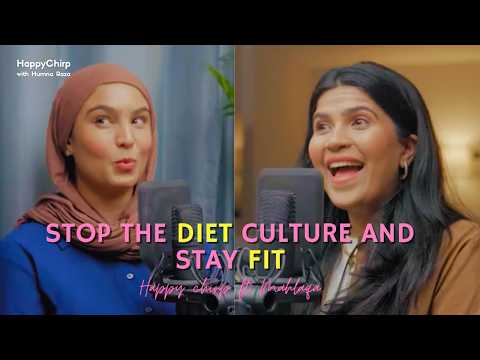 1:48:08
 Jun 6, 2026
Aim fit and live well! ft. Mahlaqa Shaukat
with Mahlaqa Shaukat
Diving into some extremely insightful conversations with Mahlaqa Shaukat, owner and founder of Pakistans gym Aim Fit that changed the fitness scene in the country.
Listen →Never miss what's next.
New writing and conversations, straight to your inbox.
One short letter a week. No spam, no pressure.