Happy Chirp · Ep 148 · Jan 2, 2024 · 1:16:52
Living Fearlessly: A Guide to Self Acceptance Ft. Bihamaal
Tonight, meet Bihamaal.
with Bihamaal
8 min read
This one is a conversation with Bihamaal, who you might know as Beal. She is a multi-medium artist, someone who creates in whatever form speaks to her, and she uses that creativity to talk openly about bodies, about the politics of being seen, and about the quiet work of accepting yourself.
We sat down and I asked her the real stuff. What does it mean to exist in a body that people feel entitled to comment on? How do you heal when the world keeps telling you you are too much or not enough? And what happens when the internet turns you into a product instead of a person?
This conversation is raw, honest, and full of the kind of wisdom that comes from going through the fire and coming out still willing to be soft. I learned so much from her, and I think you will too.
The artist who tried to escape art
Bihamaal grew up in Lahore, an only child raised by a single mother. She calls herself a rebel, the outcast who never quite fit the stereotype of her school. People would tell her to focus on practical things, get a real job, and she tried. She switched degrees three times, went from wanting to be a surgeon to studying film abroad, then psychology, then finally landing at BNU in Liberal Arts and Social Sciences.
That place gave her belonging. She says, “I finally felt like oh, I belong. This is what I’ve been looking for.” Her teachers changed her life, and she met other progressive, like-minded people. But art kept pulling her back. “It kept coming back to me in many many ways,” she says. Photography, videography, illustration, makeup, graphic design. She calls herself a multi-medium artist because her expression shifts depending on what she is feeling.
Now she creates a character of her younger self, a baby version, to heal the parts of her that once felt unworthy. “I felt like younger me would be proud of me,” she tells me, and that simple conviction carries so much weight. She is making art for the girl who didn’t have someone like her to look up to.
When your mother gets cancer and nothing else matters
In 2020, just as Bihamaal was finishing her thesis and dreaming of a masters and PhD, her mother was diagnosed with stage two breast cancer. She is an only child. Her mother is a single mother. The plan she had was immediately irrelevant. “Life was just like, hey, I have another sort of plan for you,” she says.
She describes that year and a half as one that aged her. She grew up fast, learning that so many things she gave mental energy to didn’t actually matter. Watching her mother go through treatment, surviving, being a “badass” as she calls her, reshaped her priorities. There is a quiet strength in the way she talks about it. She still thanks her joint family for their support, but you can hear that this was an experience that stripped away the trivial.
I related deeply. My father passed away from cancer, and my own mother is that same kind of superwoman. We both know what it is to see a parent fight that fight. Bihamaal and I sat with that shared understanding, and it reminded me that the hardest seasons can also be the ones that teach you what actually matters.
Body neutrality: your body does not define your value
I asked Bihamaal what body positivity means to her, and she gently shifted the frame. She doesn’t label herself with that term. She leans toward body neutrality, the idea that your body is not what gives you value. “Your body is sometimes the last thing you need to look at when you’re looking at your own value as a person,” she explains.
She talks about the systemic anti-fat bias, the ways larger bodies are penalized, demonized, othered. But her goal isn’t just self-love. It’s the radical idea that the first thing you notice about someone shouldn’t be their body. She says it simply: “This is none of my business what they do with their body. That is none of my business.”
When she hears people compliment her by saying “you’re so brave” for wearing certain clothes or existing in her skin, she bristles. “I’m not brave for existing in my body. I’m just existing. I’m not brave for wearing the clothes I wear. I’m just wearing them. You wouldn’t say this to a slimmer person, so why is it brave when I do it?” That distinction lands hard. The compliment carries an undertone of shock that someone who looks like her could simply be comfortable.
She tells a story about an auntie at a high tea who called her over just to say, “Oh my God, I hate how much weight you’ve put on.” Bihamaal was taken aback but didn’t fight. She just said thank you, because sometimes you pick your battles. Her takeaway was simple: “Don’t become this.” And she wants her generation to stop the cycle.
Therapy saved me, and I mean it literally
Bihamaal speaks about therapy with a kind of reverence. She says, “I would not be here physically if it wasn’t for therapy. It 100% saved me.” She went after a period of severe PTSD that left her so sensitive that hearing certain words would bring on a panic attack. A teacher at BNU noticed, asked if she had ever talked to a therapist, and that gentle nudge started a process that changed everything.
She had three terrible experiences with therapists before finding the right one. But she didn’t stop. She knew she owed it to herself to keep trying. “It’s almost like holding up a mirror,” she says, “and I know that’s very difficult, but it can do wonders if you decide to take that step.”
Therapy taught her to draw boundaries, to ask for help, and to see that healing is not a one-time fix. “You’re still going to run into bad situations, bad people, bad traumas, and you’re not going to be perfect. You just learn to not let those things define you.” She still goes for checkups, even when she feels fine, because those underlying things have a way of resurfacing.
She emphasized something I hold close: your friends, your parents, your partner are not your therapists. “Don’t make one person everything. It’s never going to work out, and it’s not fair to them.” A therapist offers non-biased, objective guidance, and that boundary is exactly what makes it safe.
The internet dehumanizes you, and you have to protect your spirit
We got real about what it feels like to be online as a visible person. Bihamaal is raw about it. “I’m a human being,” she says. “Behind this is a natural person with feelings.” But the comments section often forgets that. People project their own anger, their own insecurities, and they use you as a release.
She spoke about the pressure of being called a public figure when she never asked for that responsibility. “I did not choose this life,” she admits. “I love what I do, but I am so tired of it too. I never wanted this many eyes on me.” Every time she sees her image on a billboard, she freaks out. She is a private person who happens to be visible, and that contradiction is heavy.
The cancel culture, the pedestal, the expectation that she must always have the right thing to say. She reminds us that we are all flawed, and we all make mistakes. “If I’m giving myself that grace to make a mistake and learn from it, as a viewer, do the same. Just be a bit more humane.” That line stuck with me. So often we dehumanize public figures and then turn around and demand they be perfect. Bihamaal refuses to play that game. She is just a person, doing her best, and she hopes we can all extend a little more leniency.
Small moments that built her self-acceptance
When Bihamaal was struggling with body dysmorphia and disordered eating, she started with her phone. She unfollowed anyone who promoted diet culture or didn’t look like her. She filled her feed with women who had bodies like hers, living full, healthy lives. It broke her heart that she couldn’t find many in Pakistan, and that lack of representation is exactly why she became Beal.
She wanted to be the person she needed as a kid. “I wanted someone like me,” she says. That small act of curating her feed was the first step toward seeing herself differently. Then came the selftalk, the quiet decision to stop hating herself. She didn’t announce it; she just started.
Now she channels that into art. Recently she created an animation of a character that is both her adult self and baby her, a way of healing her inner child. “I felt like I really owed that to myself,” she says. She is proving that representation and creativity are not just nice to have. They can be lifelines.
I left this conversation thinking about how many of us are walking around with the weight of other people’s opinions, and how Bihamaal’s journey shows that unlearning is possible. It is not a straight line. It takes therapy, community, and a decision to stop giving power to the voices that never served you. But it is real, and it starts with small things, like who you follow and how you speak to yourself.
If this episode gave you something to hold onto, share it with a friend who might need it. And know that wherever you are in your own journey, you are allowed to take up space, exactly as you are.
More from Happy Chirp
 1:17:01
 Jul 2, 2026
From scratch: Building the life you dreamed of!
with Anum
Anum left her comfort zone repeatedly and never stopped dreaming about what she wanted to achieve.
Listen → 1:29:31
 Jun 18, 2026
Do women dim their light to protect their peace? ft. Hira Hafeez
with Hira Hafeez
How Hira made it in life is a story packed with hard work, consistent faith and divine intervention. One of my favourite conversations on the platform, and you know thats saying something.
Listen →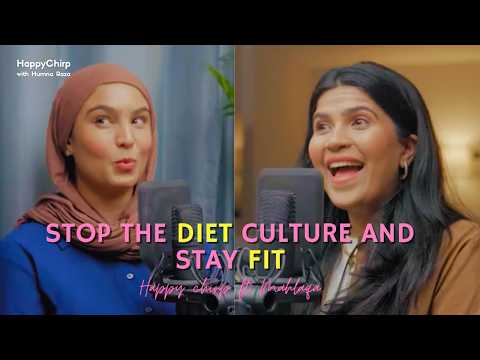 1:48:08
 Jun 6, 2026
Aim fit and live well! ft. Mahlaqa Shaukat
with Mahlaqa Shaukat
Diving into some extremely insightful conversations with Mahlaqa Shaukat, owner and founder of Pakistans gym Aim Fit that changed the fitness scene in the country.
Listen →Never miss what's next.
New writing and conversations, straight to your inbox.
One short letter a week. No spam, no pressure.