Happy Chirp · Ep 150 · Jan 16, 2024 · 1:16:32
Raw, Real & Radiant Ft. Manalmuffin
Tonight, meet Manal. From the transformative impact of hijab to her unexpected journey into content creation, she shares the beauty of her experiences.
with Manal
10 min read
This is the last episode of this season and number 150 for Happy Chirp, and honestly, I am still surprised that I made it this far. I started this podcast when I was pregnant, navigated postpartum, burnout, and those moments where I just wanted to give up. There were breaks I had to take for my mental and physical well-being, but I always returned. We have always been independent here, no sponsor, no big company pushing this forward, just me showing up and you tuning in. I am so grateful for that.
Today I sit down with Manal, known to her community as Manalmuffin. She is a Dubai based content creator who has been building her space in the beauty world for years now. But this conversation is not just about makeup. We talk about the car accident that ended her university plans and accidentally started her career, the struggle of third culture identity, and the deeply personal decision she made in 2023 to start wearing the hijab as a public figure. She is raw about how hard that was, the backlash, the moment she almost quit, and how she finally made peace with it.
An accident and an accidental career
Manal was born in Lahore, but Dubai has been her home since she was seven. She grew up here, studied here, and always felt that magnetic pull back to the city. She calls it that third culture kid vibe. Her path was supposed to lead through university. She had already deposited her admission fees and was ready to start a degree in media, dreaming of becoming a magazine editor or working in public relations. Then life shifted in a split second.
She was crossing the road with her mom when a car did not see her and hit her. The result was a major brain injury and a stay in the ICU. She tells me about those twenty five days in the hospital, the miracle of surviving without paralysis, and the long healing that followed. “I used to be so cranky. I don’t know what happened in my brain, like chemistry fully went upside down,” she says. The brain bleeding meant she could not continue with university. At 18, while her friends moved forward, she felt stuck and depressed, wondering what she was doing with her life.
In that free time, she turned to the beauty creators she had always admired. She picked up her phone, used natural window light, filmed a basic makeup tutorial, and uploaded it. It hit 16,000 or 18,000 views when she only had about 600 followers. She was shocked. Her family, especially her parents, supported her completely even when they did not fully understand what content creation meant back in 2017. Her mother became her biggest cheerleader, telling everyone to follow her. Slowly, the pain of dropping out faded as a new career took shape. She realized the main reason people go to university is to earn, and she was already doing that by being authentic in front of a camera.
The beauty of not being perfect
I was curious why beauty stuck for her. She traces it back to her childhood in Pakistan, doing little fashion shows with her young aunts, draping her mom’s dupatta like a sari, and being gifted a lipstick for good grades. But the real shift came when she became a face model for makeup artists. She was their canvas, and as they worked, she asked questions and learned. A masterclass with Huda Beauty in 2016 sealed it. She walked away with a bag of products worth around five thousand dollars and a head full of knowledge that she poured straight into her first videos.
What strikes me most is her relationship with perfection. She never had one. “I didn’t care about perfection. I just posted,” she tells me. In her early videos, she would start looking completely crusty, as she puts it, with messy hair and zero makeup. By the end, the transformation was complete. People connected to that because it was real. They saw themselves in her before and after. That relatability built her community.
She says the industry has changed completely since those early days. Back then, going viral felt easier, and the algorithm actually worked in your favor. A shoutout from a big name could bring ten thousand real, active followers. Now, the space is saturated. Attention spans are shorter. People might like a post on the reel tab without ever hitting follow. “The sense of community that existed on Instagram before, we’ve lost that,” she says. Her focus now is firmly on value driven content and teaching something in every post. She believes that chasing numbers is pointless if you lose connection. Growth might be slower when you prioritize depth, but the people who stay are the ones who truly matter.
Growing up with curly hair and the ‘log kya kahenge’ mindset
Our conversation shifts to beauty standards, and Manal is open about the insecurity that shaped her younger years. Growing up with super curly hair, she faced nicknames and comments from relatives that made her feel like her natural texture was not beautiful. It is a classic Desi experience, the log kya kahenge, what will people say, creeping into your self image. She begged her mother to let her permanently straighten her hair. Her mother refused, telling her she had beautiful hair. But the comments had already done damage.
For years, she was a rebel against her own curls. She did not even have a straightener, so she resorted to DIY methods no one should try, placing her hair on an ironing board and using a real iron on it because she was obsessed with having straight hair. She thought straight hair meant more beautiful, more civilized. It was not until 2020, when she finally got the permanent straightening she had always wanted, that she looked in the mirror and asked herself what she was doing. By then, the excessive heat had permanently damaged her curl pattern, and she has now made peace with her wavy hair. She tells me it was a subconscious thing instilled in her head. She has had to unlearn it, just like we all unlearn the idea that we need to look a certain way to be acceptable.
Putting on the hijab while the whole world watches
The core of our conversation lands on her decision to start wearing the hijab at the beginning of 2023. It is a huge shift for anyone, but doing it as a beauty content creator in Dubai where your image is your portfolio adds a layer of pressure most people never have to think about. Manal had always had a timeline in her head: maybe after marriage, maybe after this, maybe after that. Then she went for Umrah for the first time.
She describes that trip as the most spiritual journey she has ever felt. Seeing the Kaaba changed something. During her time in Makkah and Madinah, she kept her hijab on and simply did not feel like taking it off afterward. While still there, she started archiving her old posts, feeling disconnected from the temporary, worldly race. She came back to Dubai and kept it on. But she is honest that it comes in waves. The high of Makkah slowly met the routine of daily life, and doubt crept in.
The public scrutiny was immediate and intense. Her audience, which had once celebrated her fashion sense, now put her under a microscope. A strand of hair showing, a painted nail, it all became an invitation for judgment. She tells me it felt like being a hypocrite, like she was not good enough for this choice. People would say, “Your one strand is showing,” or question why she had nail paint on. She thought to herself, I never had these issues without the hijab. What is happening? Maybe I should just take it off.
At her lowest, she actually filmed a four minute video without her hijab on, explaining why she was quitting. She never posted it. She spoke to her mother, who never forced her but encouraged her to think deeply. She prayed. And then her mind switched again. Watching Palestinian women hold onto their hijabs while facing unimaginable loss and hardship, she realized her problem was nothing compared to theirs. Her struggle was not about the cloth itself but about the voices of people nitpicking her every move. She made a decision right then that her intention was to please God, not the comments section. “The more you struggle, the more your reward is higher,” she says. Once she truly embraced that, she stopped hiding and started showing up fully again.
The religion that gave women their rights
The conversation naturally expands beyond the headscarf. Manal is passionate about women understanding their value through Islam and separating faith from toxic cultural traditions. She points out that Hazrat Khadijah was a trader herself. Islam never stopped women from working. The Mah, the gift a woman can ask for at marriage, has no limit. A woman is not required to take her husband’s name because her identity is her own lineage, not a transfer of ownership. A wife is not Islamically obligated to cook and clean; her primary honor is in shaping the next generation, which is why Jannat lies under the feet of the mother.
I find myself adding to her thoughts, reflecting on how the hijab is often misunderstood as a tool of oppression when in reality, it is meant to protect women from being reduced to their bodies and their looks. It allows you to say, I am a person, take me seriously for my thoughts and my qualifications. Manal agrees. She says that when she goes out covered, she feels she has the authority to decide who gets to see her beauty. It gives her a sense of empowerment rather than limitation. The men she encounters in Dubai are more respectful, giving her space, letting her enter an elevator first. She felt a confidence she did not expect, a sudden boost that surprised her.
Being Pakistani in a beauty industry built for Arabs
Manal also sheds light on what it means to be a Pakistani content creator navigating an industry where the main language and gatekeepers are often Arab. For years, she could land international brand deals before local UAE brands would trust her. An Arab creator with fewer followers might get an opportunity simply because she speaks Arabic and appeals to the Emirati or Saudi market. But Manal kept working, proving that the Desi community buys, that they trust, and that they show up. She tells me about launching a perfume with another brand where the first batch sold out completely. That was her proof. Now, more Pakistanis and Indians hold positions in marketing and influencer management, and they understand the power of this audience. It is no longer a market that can be ignored.
This is a conversation about transformation in the truest sense. Not just a makeup before and after, but a life before and after. Manal is navigating her faith, her career, and her identity in public, and she is doing it with a kind of honesty that is rare. She shows that you do not need to have it all figured out to make a change. You just need to take one step, and then another, and be kind to yourself when it feels impossibly hard.
I hope you leave this episode knowing that whatever version of yourself you are growing into, it is okay if it happens in waves. It is okay to struggle. And it is more than okay to put your peace and your connection with your Creator above the noise of people who do not know your heart.
More from Happy Chirp
 1:17:01
 Jul 2, 2026
From scratch: Building the life you dreamed of!
with Anum
Anum left her comfort zone repeatedly and never stopped dreaming about what she wanted to achieve.
Listen → 1:29:31
 Jun 18, 2026
Do women dim their light to protect their peace? ft. Hira Hafeez
with Hira Hafeez
How Hira made it in life is a story packed with hard work, consistent faith and divine intervention. One of my favourite conversations on the platform, and you know thats saying something.
Listen →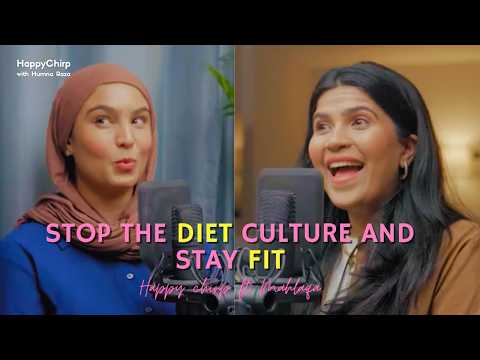 1:48:08
 Jun 6, 2026
Aim fit and live well! ft. Mahlaqa Shaukat
with Mahlaqa Shaukat
Diving into some extremely insightful conversations with Mahlaqa Shaukat, owner and founder of Pakistans gym Aim Fit that changed the fitness scene in the country.
Listen →Never miss what's next.
New writing and conversations, straight to your inbox.
One short letter a week. No spam, no pressure.